
WhatsApp USA: +1 6032769350 | WhatsApp HK: +852 63697831
Global Healthcare Medical
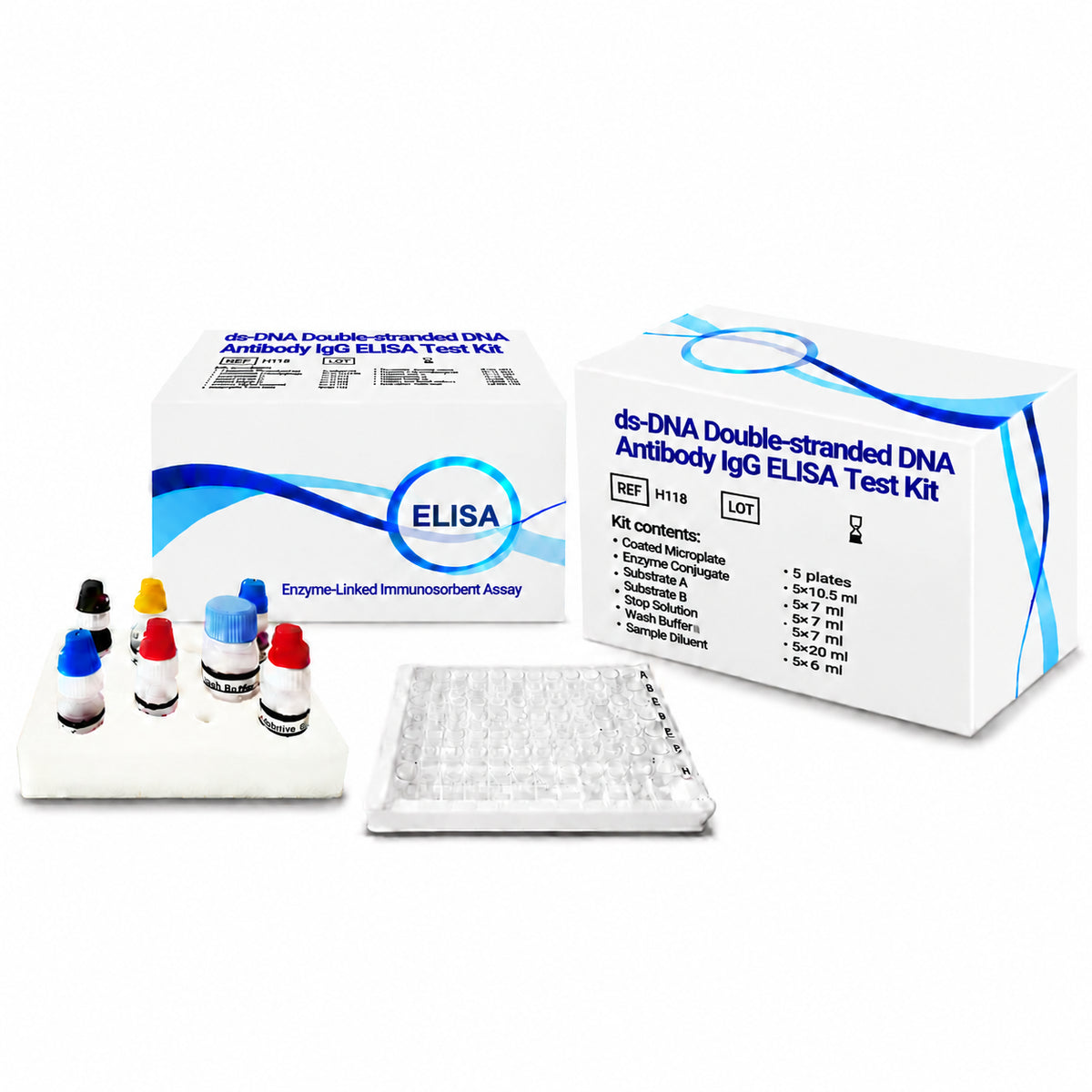
GHM ds-DNA Double-stranded DNA Antibody IgG ELISA Kit US – 96-Well Solid-Phase ELISA for Semi-Quantitative Determination of Anti-dsDNA IgG in Serum & Plasma (96T/Kit)
GHM ds-DNA Double-stranded DNA Antibody IgG ELISA Kit US – 96-Well Solid-Phase ELISA for Semi-Quantitative Determination of Anti-dsDNA IgG in Serum & Plasma (96T/Kit)
SKU: GHM ds-DNA Double-stranded DNA Antibody IgG ELISA Kit US
Brand: Global Healthcare Medical
Product Overview
Global Healthcare Medical GHM ds-DNA Double-stranded DNA Antibody IgG ELISA Kit US is a 96-well enzyme-linked immunosorbent assay (ELISA) designed for the semi-quantitative determination of immunoglobulin G (IgG)-class antibodies directed against double-stranded DNA (dsDNA) in human serum and plasma specimens. Double-stranded DNA is a highly regular macromolecular antigen: two antiparallel polydeoxyribonucleotide strands wound into the right-handed B-form helix, with the phosphodeoxyribose backbone exposed on the exterior and the base pairs stacked in the interior, accessible through the major and minor grooves. Antibody recognition of dsDNA therefore differs fundamentally from recognition of a globular protein antigen — the determinants are periodic and repeating along the helix axis, they depend on backbone geometry and groove accessibility, and a proportion of reactivity is sensitive to helical conformation rather than to any linear sequence. Anti-dsDNA antibodies are studied within the broader field of humoral responses to nucleic acid antigens, alongside other nucleic-acid-directed and nuclear-antigen autoantibody profiles.
The IgG class is the most abundant immunoglobulin isotype in serum, accounting for approximately three quarters of total serum immunoglobulin, and it is the product of class switching and avidity maturation following antigen encounter. IgG circulates as a monomeric, bivalent molecule with two antigen-binding sites per molecule, and its neonatal Fc receptor–mediated recycling pathway gives it the longest circulatory half-life among the immunoglobulin classes. For nucleic acid antigens, avidity maturation is a particularly informative parameter: repeated exposure drives selection towards higher-affinity IgG variants, and the IgG class is where such maturation is most clearly resolved. Measurement of anti-dsDNA antibody IgG is used in research settings to characterise humoral reactivity to double-stranded DNA, study immunoglobulin class distribution across nucleic-acid-directed autoantibody families, and investigate DNA antigen–antibody interaction profiles in immunological research models.
The kit employs a solid-phase ELISA principle with double-stranded DNA antigen immobilized on the solid phase and enzyme-conjugated anti-human IgG detection antibodies in the liquid phase. Results are evaluated against a cut-off value established from the assay calibrators, yielding a semi-quantitative interpretation expressed in arbitrary antibody units. The assay is configured for a 50 µL sample volume and a total incubation time of approximately 1.5–2.5 hours (depending on protocol configuration), with absorbance read at 450 nm using standard microplate ELISA equipment. The kit is supplied in a 96-test/box format with an 18-month shelf life.
Intended Use: For laboratory research use only. This product is not intended for use in diagnostic procedures, not for therapeutic use, and not for clinical decision-making. Results should be interpreted by qualified laboratory professionals in the context of research applications.
Key Features & Benefits
Solid-Phase ELISA for Anti-dsDNA Antibody IgG Detection
The assay utilizes a solid-phase ELISA format in which double-stranded DNA antigen is immobilized on the 96-well microplate and enzyme-conjugated anti-human IgG detection antibodies are supplied in liquid phase. This configuration supports specific antibody capture and signal generation, enabling evaluation of IgG-class anti-dsDNA reactivity in serum and plasma matrices. Because the detection conjugate is directed against the gamma heavy chain of human IgG, the readout is restricted to the IgG isotype and does not report total anti-DNA immunoglobulin content — an important distinction when IgG and IgM classes are studied as separate analytes.
|
Feature |
Benefit |
|
Solid-phase ELISA format |
Established principle for anti-dsDNA antibody detection |
|
Anti-human IgG detection |
IgG-isotype specific readout, not total immunoglobulin |
|
Double-stranded DNA coating |
Presents helical backbone and groove determinants |
|
Cut-off value evaluation |
Standardised semi-quantitative interpretation |
Double-Stranded Specificity as a Design Requirement
A central technical difficulty in anti-DNA serology is that single-stranded DNA (ssDNA) is far more immunogenic as a laboratory artefact than dsDNA, and ssDNA contamination of the solid phase produces reactivity that is not dsDNA-specific. Because the determinants of interest lie on the intact double helix — the phosphodeoxyribose backbone in its B-form geometry and the base-pair edges presented within the grooves — the antigen must be presented in a double-stranded, conformationally intact state, with single-stranded regions removed or rendered non-reactive. This configuration is therefore built around a dsDNA-specific antigen presentation rather than a crude nucleic acid coat, which is what allows anti-dsDNA reactivity to be resolved from the far more broadly reactive anti-ssDNA background. The distinction matters analytically: dsDNA reactivity is far more restricted in its determinant repertoire, and formats that do not control for strandedness over-report it.
|
Feature |
Benefit |
|
dsDNA-specific antigen presentation |
Resolves dsDNA reactivity from anti-ssDNA background |
|
Conformationally intact helix |
Preserves backbone and groove determinants |
|
Restricted determinant repertoire |
More specific analytical window than crude nucleic acid coats |
|
Distinct from ssDNA formats |
Complements single-stranded DNA configurations |
IgG Class and Avidity Maturation on a Periodic Epitope Array
The B-form helix presents its determinants periodically along the helix axis, so the antigen surface is a repeating array rather than a set of discrete sites. IgG engages this array through its defined two-site stoichiometry, and because the two Fab arms can span adjacent turns of the helix, bivalent binding across neighbouring determinants contributes to the measured avidity in a way that depends on helical geometry and antigen density. Following class switching, somatic hypermutation and avidity maturation raise the intrinsic affinity of the IgG pool, and avidity is a particularly informative readout for nucleic acid antigens because repeated exposure selects progressively higher-affinity variants. IgG is consequently the isotype with the largest body of comparable published data in nucleic-acid autoantibody research, and IgG results are commonly used as the reference axis when other isotype data are interpreted alongside them.
|
Feature |
Benefit |
|
Monomeric bivalent IgG |
Defined two-site stoichiometry; reproducible capture |
|
Bivalent spanning of adjacent determinants |
Avidity readout sensitive to helical geometry |
|
Affinity-matured IgG pool |
Resolves avidity maturation across exposures |
|
Reference-axis positioning |
Supports interpretation of paired isotype data |
Performance Aligned with Published Anti-dsDNA Antibody ELISA Benchmarks
Published performance data for ELISA-format anti-dsDNA antibody assays are comparatively variable between platforms, and unit definitions vary between referenced configurations. Available product data for nucleic-acid-antigen autoantibody ELISA formats report sample volumes of 50–100 µL, a colorimetric microplate readout at 450 nm, and time to results of approximately 1–5 hours, with results expressed in arbitrary antibody units referenced to kit calibrators and interpreted against a cut-off value rather than a mass-concentration standard. Precision data for antibody-class ELISA formats of this type generally indicate intra-assay CV values below 10% and inter-assay CV values below 15%. Sample volumes of 50 µL are used in this configuration, and absorbance is read at 450 nm. Because absolute unit values obtained on different platforms are not directly interchangeable, laboratory professionals should confirm the applicable calibrator definitions against the kit documentation supplied with each lot.
|
Feature |
Benefit |
|
Cut-off value based semi-quantitative readout (published benchmark) |
Standardised qualitative and semi-quantitative framework |
|
Intra-assay CV <10%; inter-assay CV <15% (published benchmark) |
Repeatability and reproducibility suitable for laboratory use |
|
Arbitrary antibody unit reporting |
Consistent with established anti-DNA ELISA practice |
Standardized 96-Well Workflow with 50 µL Sample Volume
The assay is formatted for standard 96-well microplate processing with a 50 µL sample volume and a total incubation time of approximately 1.5–2.5 hours. Absorbance is measured at 450 nm, aligning with widely available ELISA readers and washers.
|
Feature |
Benefit |
|
96 tests/box |
Practical batch configuration for research workflows |
|
50 µL sample volume |
Standard ELISA sample requirement |
|
450 nm reading |
Compatible with common microplate spectrophotometers |
|
~1.5–2.5 hour total incubation |
Efficient turnaround for batch processing |
18-Month Shelf Life
Extended reagent stability supports inventory planning and reduces replacement frequency in laboratory settings.
|
Feature |
Benefit |
|
18-month shelf life |
Extended inventory stability |
|
Consistent batch supply |
Supports repeatable research workflows |
Kit Contents & Pricing (EXW US Dollar)
|
Product Description |
Package |
Shelf Life |
Price/Kit (USD) |
CPT (USD/Test) |
|
ds-DNA Double-stranded DNA Antibody IgG ELISA Kit |
96 Tests/Box |
18 Months |
$38.00 |
$0.3958 |
Cost per test: approximately $0.40, based on a 96-test kit configuration.
Product Specifications
|
Specification |
Detail |
|
Model / SKU |
GHM ds-DNA Double-stranded DNA Antibody IgG ELISA Kit US |
|
Product Type |
Enzyme-Linked Immunosorbent Assay (ELISA) Kit |
|
Intended Use |
Semi-quantitative determination of anti-dsDNA antibody IgG in human serum or plasma; for laboratory research use only; not for use in diagnostic procedures; not for therapeutic use |
|
Assay Principle |
Solid-Phase ELISA with anti-human IgG detection |
|
Target Analyte |
Anti-double-stranded DNA antibody, immunoglobulin G (IgG) class |
|
Immunoglobulin Class |
IgG (gamma heavy chain specific; monomeric, bivalent) |
|
Antigen |
Double-stranded DNA (B-form helical antigen presentation) |
|
Specimen Types |
Human serum, plasma |
|
Specimen Volume |
50 µL/well |
|
Package Size |
96 Tests/Box |
|
Shelf Life |
18 Months |
|
Reading Wavelength |
450 nm |
|
Total Incubation Time |
Approximately 1.5–2.5 hours (protocol-dependent) |
|
Precision (published benchmark) |
Intra-assay CV <10%; inter-assay CV <15% |
|
Result Interpretation |
Cut-off value based semi-quantitative readout (published benchmark) |
|
Calibration Format |
Arbitrary antibody units referenced to kit calibrators (not mass-concentration calibrated) |
|
Regulatory Status |
Manufactured under EN ISO 13485 certified quality management system |
Why Laboratories Choose Global Healthcare Medical
|
Consideration |
GHM ds-DNA Double-stranded DNA Antibody IgG ELISA Kit US |
|
Solid-phase ELISA with anti-human IgG detection |
IgG-isotype specific readout, not total immunoglobulin |
|
dsDNA-specific antigen presentation |
Resolves dsDNA reactivity from anti-ssDNA background |
|
Conformationally intact B-form helix |
Preserves backbone and groove determinants |
|
Monomeric bivalent IgG |
Defined two-site stoichiometry; reproducible capture |
|
Performance aligned with published anti-dsDNA ELISA benchmarks |
Cut-off value based; CV <10%/<15% |
|
Cost-effective research serology |
$0.3958 per test; $38.00 per 96-test kit |
|
18-month shelf life |
Extended inventory stability |
|
Standard 96-well format |
Compatible with routine ELISA equipment |
|
ISO 13485 certified |
Quality management system compliance |
About Global Healthcare Medical
Global Healthcare Medical connects clinical laboratories, research institutions, and blood screening centers with diagnostic reagents and analytical systems designed for reliable operation in demanding healthcare environments. The GHM ds-DNA Double-stranded DNA Antibody IgG ELISA Kit US is part of our professional ELISA reagent portfolio, developed to support standardized, reproducible laboratory workflows.
Our focus is on dependable analytical performance, clear documentation, and responsive support for professional laboratory operations.