
WhatsApp USA: +1 6032769350 | WhatsApp HK: +852 63697831
Global Healthcare Medical
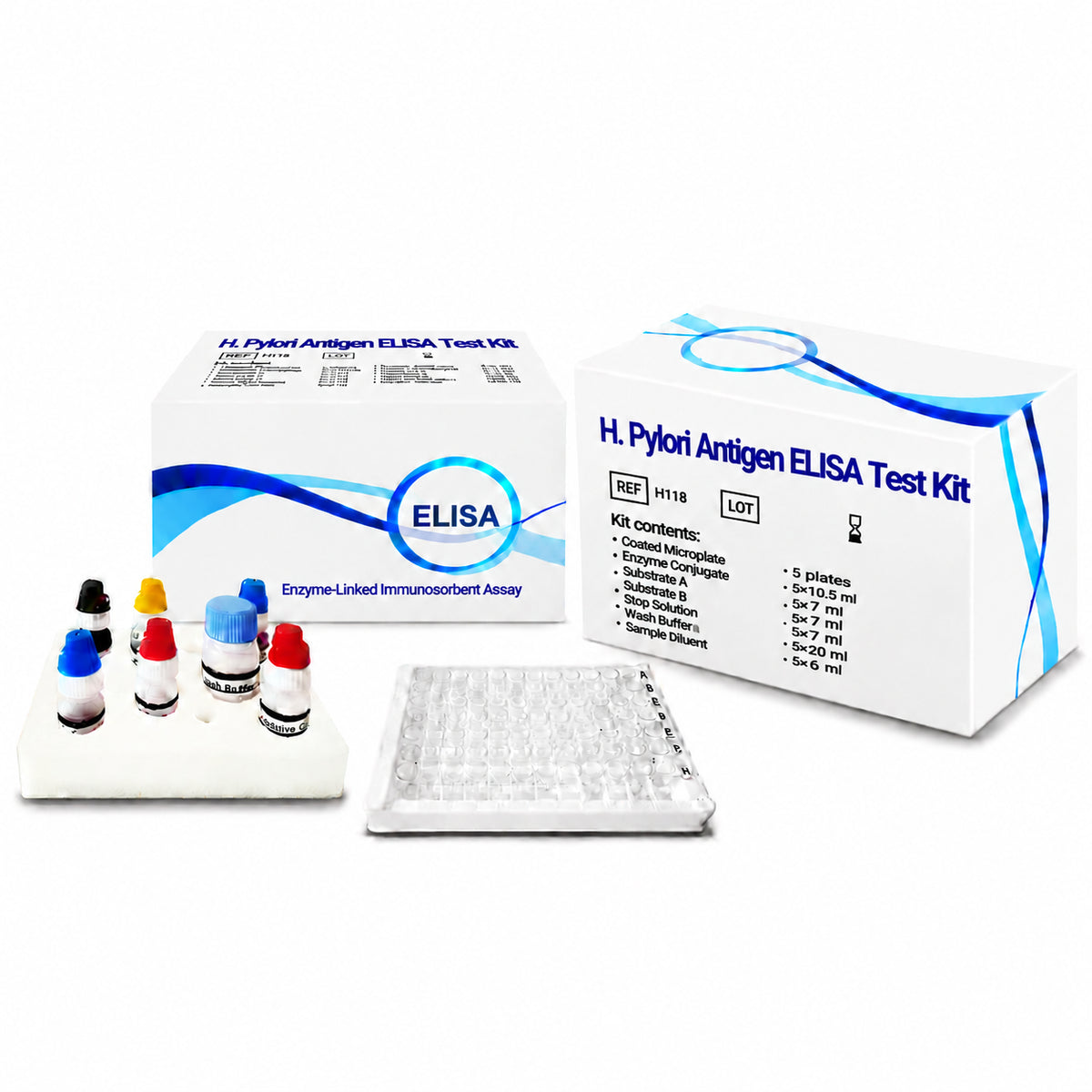
GHM H. Pylori Antigen ELISA Kit US – 96-Well Sandwich ELISA for Semi-Quantitative Determination of Helicobacter pylori Antigen in Stool (96T/Kit)
GHM H. Pylori Antigen ELISA Kit US – 96-Well Sandwich ELISA for Semi-Quantitative Determination of Helicobacter pylori Antigen in Stool (96T/Kit)
SKU: GHM H. Pylori Antigen ELISA Kit US
Brand: Global Healthcare Medical
Product Overview
Global Healthcare Medical GHM H. Pylori Antigen ELISA Kit US is a 96-well enzyme-linked immunosorbent assay (ELISA) designed for the semi-quantitative determination of Helicobacter pylori antigen in human stool specimens. H. pylori is a microaerophilic, Gram-negative, spiral-shaped bacterium characterised by a multiflagellate polar morphology that drives its corkscrew motility, a highly active urease enzyme complex (UreA/UreB) that hydrolyses urea into ammonia and carbon dioxide, and a set of outer-membrane adhesins — including BabA and SabA — that bind fucosylated and sialylated glycan structures of the Lewis antigen family. The bacterium also carries the cag pathogenicity island encoding the CagA effector protein and the vacuolating cytotoxin VacA. H. pylori is studied within the broader field of gastric microbial ecology and bacterial antigen detection, and its antigenic components are well characterised at the molecular level.
This product is an antigen-detection assay, not an antibody-detection assay. The analyte measured is the bacterial antigen itself, captured directly from the specimen by immobilized anti-H. pylori antibodies. This is an analytically distinct measurand from a serological determination: an antigen assay reports the presence and relative abundance of bacterial antigenic material in the specimen, whereas an antibody assay reports the host humoral response, which is a different quantity with different kinetics and different determinants of positivity. Because no immunoglobulin class is involved, the assay carries no isotype dimension and no class-switching consideration — the readout is a direct function of antigen capture. Measurement of H. pylori antigen is used in research settings to characterise bacterial antigen shedding, study antigenic load in gastrointestinal microbial research models, and investigate bacterial antigen–antibody interaction profiles in microbiological research.
The kit employs a two-site sandwich ELISA principle: anti-H. pylori capture antibodies are immobilized on the solid phase, bacterial antigen in the specimen is bound by the capture antibody, and enzyme-conjugated anti-H. pylori detection antibodies directed against a distinct, non-overlapping epitope on the same antigen complete the sandwich. Results are evaluated against a cut-off value established from the assay calibrators, yielding a semi-quantitative interpretation expressed as a cut-off index. The assay is configured for a 50 µL sample volume and a total incubation time of approximately 1.5–2.5 hours (depending on protocol configuration), with absorbance read at 450 nm using standard microplate ELISA equipment. The kit is supplied in a 96-test/box format with an 18-month shelf life.
Intended Use: For laboratory research use only. This product is not intended for use in diagnostic procedures, not for therapeutic use, and not for clinical decision-making. Results should be interpreted by qualified laboratory professionals in the context of research applications.
Key Features & Benefits
Two-Site Sandwich ELISA for Direct Bacterial Antigen Capture
The assay utilizes a two-site sandwich format in which anti-H. pylori capture antibodies are coated onto the 96-well microplate and enzyme-conjugated anti-H. pylori detection antibodies are supplied in liquid phase. Signal is generated only when both antibodies bind the same antigen molecule simultaneously, which is the defining advantage of the sandwich configuration: it introduces a second layer of specificity beyond simple binding, because a detection antibody that recognises a different antigen cannot produce a signal. This dual-epitope requirement reduces the contribution of non-specific binding relative to single-antibody formats, and it makes the readout proportional to antigen concentration across the assay range rather than merely indicating the presence of binding activity.
|
Feature |
Benefit |
|
Two-site sandwich format |
Second specificity layer from dual-epitope requirement |
|
Direct antigen capture |
Measures bacterial antigen, not host antibody |
|
Signal proportional to antigen concentration |
Quantitative relationship across the calibration range |
|
No isotype dimension |
Single measurand; no class-switching consideration |
Paired Antibody Selection on Non-Overlapping Epitopes
The analytical performance of a sandwich assay rests on the antibody pair, not on either antibody alone. Capture and detection antibodies must bind distinct, non-overlapping epitopes on the same antigen molecule, and they must do so without steric interference — if the epitopes are too close, binding of the capture antibody blocks detection, and the sandwich fails even though both antibodies are individually functional. This configuration is therefore built around a validated antibody pair selected for epitope compatibility, and the pair is directed at abundant, structurally robust antigenic components of the organism, which matters because the antigen must survive transit through the specimen matrix and remain recognisable in its native or near-native form. This is the central design consideration that distinguishes a sandwich antigen assay from an antibody-detection ELISA, where the analyte is the immunoglobulin itself.
|
Feature |
Benefit |
|
Validated antibody pair |
Epitope compatibility confirmed; no steric interference |
|
Non-overlapping epitope requirement |
Sandwich formation is structurally possible |
|
Robust antigenic targets |
Antigen remains recognisable in the specimen matrix |
|
Distinct design logic from antibody ELISA |
Analytic is the antigen, not an immunoglobulin |
Antigen Detection as an Analytically Distinct Measurand
Researchers frequently compare antigen and antibody results for the same organism and expect them to agree; they measure different quantities and need not track one another. An antigen assay reports the presence of bacterial antigenic material in the specimen at the time of collection. An antibody assay reports the host humoral response to that organism, which is shaped by the timing and history of exposure and by individual variation in antibody kinetics. Recognising this distinction prevents the two readout types from being treated as interchangeable, and it is the reason an antigen format is the appropriate choice for research questions about antigen presence and relative abundance rather than about host serological status. This format therefore complements rather than duplicates the serological configurations in the wider ELISA portfolio.
|
Feature |
Benefit |
|
Antigen versus antibody distinguished explicitly |
Prevents misinterpretation of readout type |
|
Suited to antigen-load research questions |
Appropriate measurand for the question asked |
|
Complementary to serological formats |
Pairs with antibody-based configurations |
|
Matrix-appropriate design |
Built for stool specimen processing |
Performance Aligned with Published Sandwich Antigen ELISA Benchmarks
Published performance data for ELISA-format bacterial antigen assays report sample volumes of 50–100 µL of processed specimen, a colorimetric microplate readout at 450 nm, and time to results of approximately 1–5 hours, with results expressed as a cut-off index derived from kit calibrators rather than a mass-concentration standard. Precision data for sandwich antigen ELISA formats of this type generally indicate intra-assay CV values below 10% and inter-assay CV values below 15%. Sample volumes of 50 µL are used in this configuration, and absorbance is read at 450 nm. Because stool is a heterogeneous matrix, laboratory professionals should follow the specimen processing and dilution instructions supplied with each lot and confirm the applicable calibrator definitions against the kit documentation.
|
Feature |
Benefit |
|
Cut-off index based semi-quantitative readout (published benchmark) |
Standardised qualitative and semi-quantitative framework |
|
Intra-assay CV <10%; inter-assay CV <15% (published benchmark) |
Repeatability and reproducibility suitable for laboratory use |
|
Matrix-appropriate processing guidance |
Consistent handling of a heterogeneous specimen |
Standardized 96-Well Workflow with 50 µL Sample Volume
The assay is formatted for standard 96-well microplate processing with a 50 µL sample volume and a total incubation time of approximately 1.5–2.5 hours. Absorbance is measured at 450 nm, aligning with widely available ELISA readers and washers.
|
Feature |
Benefit |
|
96 tests/box |
Practical batch configuration for research workflows |
|
50 µL sample volume |
Standard ELISA sample requirement |
|
450 nm reading |
Compatible with common microplate spectrophotometers |
|
~1.5–2.5 hour total incubation |
Efficient turnaround for batch processing |
18-Month Shelf Life
Extended reagent stability supports inventory planning and reduces replacement frequency in laboratory settings.
|
Feature |
Benefit |
|
18-month shelf life |
Extended inventory stability |
|
Consistent batch supply |
Supports repeatable research workflows |
Kit Contents & Pricing (EXW US Dollar)
|
Product Description |
Package |
Shelf Life |
Price/Kit (USD) |
CPT (USD/Test) |
|
H. Pylori Antigen ELISA Kit |
96 Tests/Box |
18 Months |
$38.00 |
$0.3958 |
Cost per test: approximately $0.40, based on a 96-test kit configuration.
Product Specifications
|
Specification |
Detail |
|
Model / SKU |
GHM H. Pylori Antigen ELISA Kit US |
|
Product Type |
Enzyme-Linked Immunosorbent Assay (ELISA) Kit |
|
Intended Use |
Semi-quantitative determination of H. pylori antigen in human stool; for laboratory research use only; not for use in diagnostic procedures; not for therapeutic use |
|
Assay Principle |
Two-site sandwich ELISA with anti-H. pylori capture and detection antibodies |
|
Target Analyte |
Helicobacter pylori antigen (bacterial antigen, not immunoglobulin) |
|
Detection Format |
Sandwich (paired antibodies binding non-overlapping epitopes) |
|
Specimen Types |
Human stool |
|
Specimen Volume |
50 µL/well (processed specimen) |
|
Package Size |
96 Tests/Box |
|
Shelf Life |
18 Months |
|
Reading Wavelength |
450 nm |
|
Total Incubation Time |
Approximately 1.5–2.5 hours (protocol-dependent) |
|
Precision (published benchmark) |
Intra-assay CV <10%; inter-assay CV <15% |
|
Result Interpretation |
Cut-off index based semi-quantitative readout (published benchmark) |
|
Calibration Format |
Cut-off index referenced to kit calibrators (not mass-concentration calibrated) |
|
Regulatory Status |
Manufactured under EN ISO 13485 certified quality management system |
Why Laboratories Choose Global Healthcare Medical
|
Consideration |
GHM H. Pylori Antigen ELISA Kit US |
|
Two-site sandwich format |
Second specificity layer from dual-epitope requirement |
|
Validated antibody pair |
Epitope compatibility confirmed; no steric interference |
|
Direct antigen capture |
Measures bacterial antigen, not host antibody |
|
Signal proportional to antigen concentration |
Quantitative relationship across the calibration range |
|
Performance aligned with published sandwich antigen ELISA benchmarks |
Cut-off index based; CV <10%/<15% |
|
Cost-effective research microbiology |
$0.3958 per test; $38.00 per 96-test kit |
|
18-month shelf life |
Extended inventory stability |
|
Standard 96-well format |
Compatible with routine ELISA equipment |
|
ISO 13485 certified |
Quality management system compliance |
About Global Healthcare Medical
Global Healthcare Medical connects clinical laboratories, research institutions, and blood screening centers with diagnostic reagents and analytical systems designed for reliable operation in demanding healthcare environments. The GHM H. Pylori Antigen ELISA Kit US is part of our professional ELISA reagent portfolio, developed to support standardized, reproducible laboratory workflows.
Our focus is on dependable analytical performance, clear documentation, and responsive support for professional laboratory operations.