
WhatsApp USA: +1 6032769350 | WhatsApp HK: +852 63697831
Global Healthcare Medical
GHM MDK-320 US Fully Auto Glycated Hemoglobin (HbA1c) Analyzer – 18-Position Ion-Exchange HPLC System with 90-Second Fast Mode, Continuous Loading and Dual IFCC/NGSP Reporting
GHM MDK-320 US Fully Auto Glycated Hemoglobin (HbA1c) Analyzer – 18-Position Ion-Exchange HPLC System with 90-Second Fast Mode, Continuous Loading and Dual IFCC/NGSP Reporting
SKU: GHM MDK-320 US
Brand: Global Healthcare Medical
Product Overview
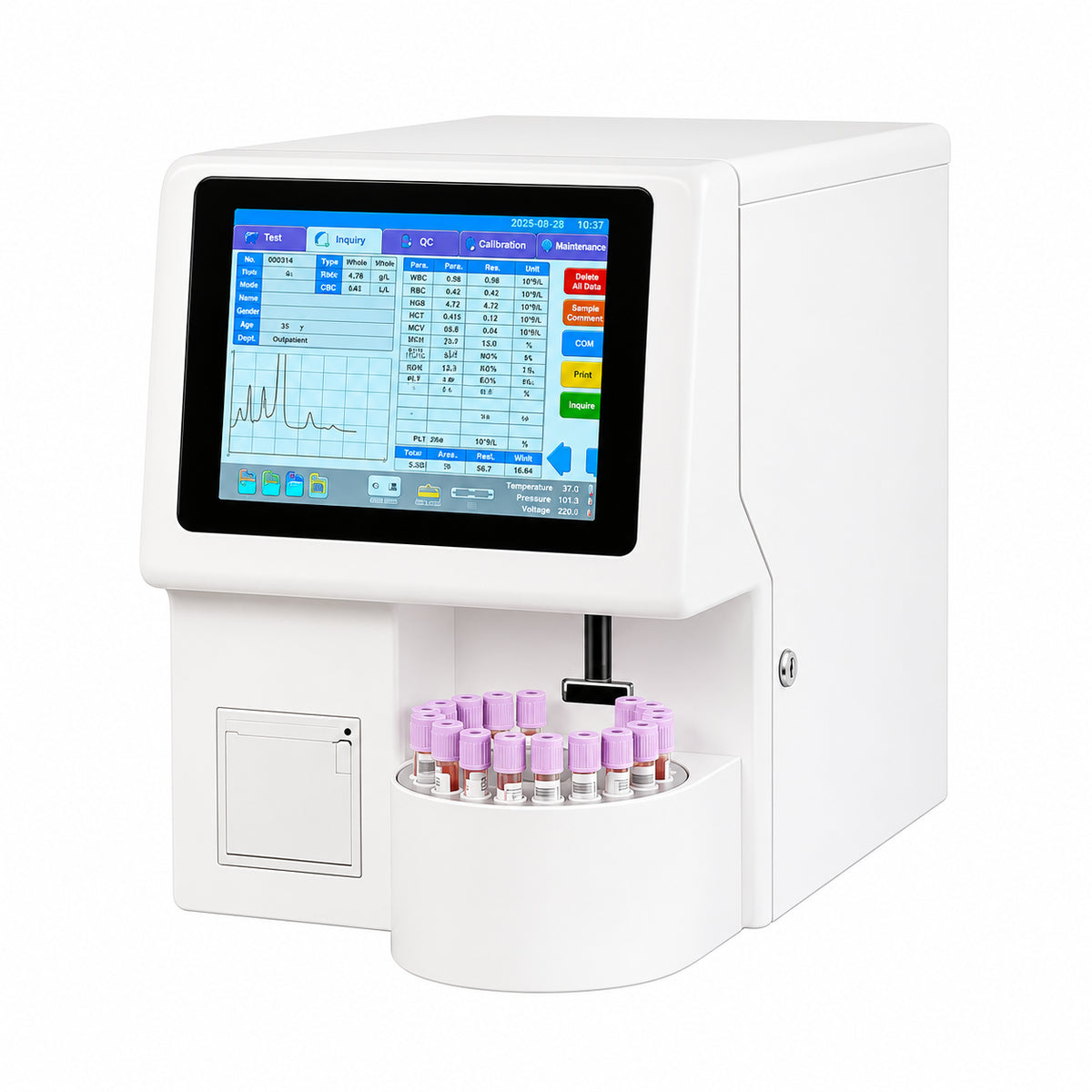
Global Healthcare Medical GHM MDK-320 US is a fully automated benchtop analyzer for the separation and quantification of glycated hemoglobin (HbA1c) and hemoglobin fractions by high-performance ion-exchange liquid chromatography (HPLC), configured with an 18-position sample carousel. It is the highest-capacity 10.4-inch-screen configuration of the GHM HPLC platform: eighteen primary tubes or sample cups loaded at once, at a 90-second Fast cycle, giving a full carousel in roughly 27 minutes of unattended run time.
The instrument performs the complete analytical sequence without operator intervention between loading and result output: the sample is identified by barcode, the primary tube cap is pierced automatically, 5 µL of whole blood is aspirated, haemolysed in-line at a 5 µL : 1,500 µL ratio, injected onto a cation-exchange column, eluted under a programmed gradient and detected at 415 nm — the absorbance maximum of the haem group. Results print on the integrated thermal printer, are written to on-board storage, and can be routed to a laboratory information system over USB.
Separation is charge-based cation exchange, not an antibody or enzymatic reaction. Hemoglobin species differ in net surface charge according to globin composition and post-translational modification; HbA1c carries additional negative charge at the N-terminal valine of the β-chain through irreversible glucose adduction and therefore elutes at a reproducible position relative to the unmodified HbA0 peak. The instrument integrates peak area across defined elution windows and reports percentage composition for each fraction — a peak-area ratio taken directly from the chromatogram, independent of reagent-lot immunoreactivity and traceable to column separation performance and pump flow stability.
Three modes are selectable in software from the same installed reagent set, with no reagent change, column change or re-plumbing. Fast mode returns a HbA1c result in 90 seconds; Variant mode (120 seconds) opens the integration window to report HbA1a, HbA1b, LA1c, stable A1c, HbA0, HbF, HbA2 and the variant fractions HbS, HbD, HbE and HbJ; A2/F mode (300 seconds) extends the run to resolve the A2 and F regions for HbA2 and HbF quantification. All results are reported in both IFCC (mmol/mol) and NGSP (%) units from a single injection.
Consumables are the 4,000-test chromatographic column, the 500-test in-line pre-sieve (nine supplied with the instrument) and buffer packs in 100, 200, 500, 1,000 and 2,000-test sizes, with every pack price listed in the pricing section below.
Intended Use: For professional laboratory use. The instrument is intended for operation by qualified laboratory personnel within a controlled laboratory environment. It is not intended for self-testing, home use, or operation by untrained personnel. Results should be interpreted by qualified laboratory professionals in accordance with the laboratory's own validated procedures and applicable local regulations.
Important: The analyzer is supplied as a main unit without the chromatographic column; the column is ordered separately as a consumable (see pricing).
Key Features & Benefits
18 Positions in a 20 kg Bench Footprint
The carousel holds 18 positions for primary tubes and sample cups, and the chassis measures 310 × 470 × 500 mm at 20 kg — the same bench envelope as a 10-position instrument. Capacity per unit of bench space is therefore the defining property of this configuration: eighteen samples queued at once on a surface that would otherwise hold ten, with no additional bench, no additional utility connection and no second operator. For a laboratory where bench space is the binding constraint rather than capital, that ratio is the practical argument for the 320 over a smaller carousel.
|
Feature |
Benefit |
|
18 sample positions |
Full working queue loaded in one pass |
|
310 × 470 × 500 mm, 20 kg |
Same bench envelope as a 10-position unit |
|
80% more positions per bench position |
Capacity without extra floor space |
|
Tubes and cups interchangeable |
Mixed collection formats in one carousel |
90-Second Cycle, Full Carousel in ~27 Minutes
At a 90-second Fast cycle, an entirely full 18-position carousel clears in about 27 minutes — a figure that matters when a morning run has to be finished before staff move to other duties. The cycle is complete, not partial: aspiration, in-line haemolysis, injection, gradient separation, 415 nm detection, peak integration, printing and storage all occur within it. Loading is continuous, one sample at a time, so positions freed during the run can be refilled without waiting for the carousel to empty.
|
Feature |
Benefit |
|
90-second complete cycle |
Aspiration to printed result inside one cycle |
|
Full carousel in ~27 minutes |
A morning queue cleared in one unattended pass |
|
Continuous loading, one sample at a time |
Freed positions refilled mid-run |
|
Automatic sample-type identification |
Whole blood recognised without operator input |
Three Modes at 90 / 120 / 300 Seconds from One Reagent Set
Fast, Variant and A2/F are software states of one hardware and reagent configuration. Fast (90 s) covers routine HbA1c; Variant (120 s) adds the extended fraction set including HbA1a, HbA1b, LA1c, stable A1c, HbA0, HbF and HbA2, plus the variant windows HbS, HbD, HbE and HbJ; A2/F (300 s) resolves the A2 and F regions for HbA2 and HbF quantification. Because all three run on the same buffers and the same column, a laboratory can move from routine throughput to extended profiling for an individual sample without interrupting reagent supply, swapping a column or recalibrating — the mode change is a software selection, nothing more.
|
Feature |
Benefit |
|
Fast 90 s / Variant 120 s / A2/F 300 s |
One platform, three cycle budgets |
|
Same buffers and column in all modes |
No swap, no re-plumbing, no recalibration |
|
HbA0 plus variant windows S, D, E, J |
Atypical peaks documented, not suppressed |
|
A2/F mode 300 s |
Extended profiling inside the working day |
Wide Measuring Range and Full Fraction Panel
The calibrated measuring range is HbA1c 3–25% (9–250 mmol/mol), HbF 0.45–45% and HbA2 0–15%. The 25% upper HbA1c boundary sits well above the 18–20% ceiling common on compact HPLC systems, so samples at the extreme high end of the distribution stay inside the calibration envelope instead of being flagged above-range and diluted by hand. Each run reports the full fraction set — HbA1a, HbA1b, LA1c, stable A1c, HbA0, HbF, HbA2 and the variant fractions — so one injection yields both a quantitative HbA1c value and a chromatogram that can be reviewed for unexpected peaks.
|
Feature |
Benefit |
|
HbA1c 3–25% |
Wider upper boundary than typical compact systems |
|
HbF 0.45–45% / HbA2 0–15% |
Extended coverage of the F and A2 regions |
|
Full fraction panel incl. HbA0 |
Quantitative result plus qualitative review |
|
Variant windows reported |
Atypical peaks are documented, not hidden |
CV ≤ 2% with Dual IFCC / NGSP Reporting
Repeatability is specified at CV ≤ 2%, and every result is reported in both IFCC (mmol/mol) and NGSP (%) units from the same chromatogram — no conversion sheet, no second run. Dual-unit output matters wherever results are exchanged with collaborators or publications that use a different convention, because one analytical measurement is presented in both reference frames at once. Chromatograms are retained on board (50,000 results, or 7,500 results with full curves) and can be exported through the independent PC software for archival reporting, curve review and trend analysis.
|
Feature |
Benefit |
|
CV ≤ 2% |
Consistent replicate performance across the range |
|
IFCC and NGSP together |
One run, two reporting conventions |
|
50,000 stored results |
Long retention without external archiving |
|
7,500 results with curves |
Chromatograms kept for retrospective review |
|
Independent PC software |
Curve review, report generation, data export |
Long-Life Consumables and Five Buffer Pack Sizes
The column is rated for 4,000 tests and the pre-sieve for 500 tests (nine supplied), so scheduled maintenance follows test count rather than the calendar. Buffer packs come in 100, 200, 500, 1,000 and 2,000-test configurations, letting a laboratory match standing inventory to its real monthly workload instead of committing to one oversized pack. Reagents carry a two-year shelf life and remain usable for three months after opening; an opened column is rated for 4,000 tests within two years of opening, so a low-volume laboratory can run a column to its rated capacity rather than discard it unused.
|
Feature |
Benefit |
|
4,000-test column |
Replacement roughly once per 4,000 results |
|
Five buffer pack sizes (100–2,000 tests) |
Inventory sized to actual monthly volume |
|
500-test pre-sieve, 9 supplied |
Filter changes known in advance |
|
2-year shelf life / 3 months in use |
Less write-off, workable open-pack window |
|
Column rated 4,000 tests over 2 years |
Full utilisation at low test volumes |
10.4-Inch Interface, LIS/HIS Connectivity and Report Control
Operation is through a 10.4-inch TFT colour LCD touch screen showing the chromatogram and the fraction table on one page, with input from the built-in barcode scanner or the touch keypad. Data leave the instrument over USB with LIS/HIS support, or through the independent PC software, which carries the chromatogram curve alongside the numeric result for formal reporting. Reports issue on the built-in thermal printer or an external printer, and report layouts can be customised to the site's own template. Buffer level is monitored continuously with an on-screen alarm for insufficient buffer, which prevents a run from starting on an inadequate reagent supply.
|
Feature |
Benefit |
|
10.4-inch colour touch screen |
Chromatogram and fraction table on one page |
|
USB with LIS/HIS support |
Direct laboratory information system integration |
|
PC software with curve output |
Formal reports carry the chromatogram |
|
Customisable report layout |
Output matched to the site's template |
|
Buffer-level alarm |
Prevents runs on insufficient reagent |
System Contents & Pricing (EXW, USD)
Analyzer configuration
|
Item |
Detail |
|
Main unit |
Fully automated HPLC HbA1c analyzer, 18-position carousel, column not included |
|
Supplied with unit |
Power cord, thermal paper roll, user manual, 9 × pre-sieve/filter |
|
Column |
Ordered separately — see consumables below |
Analyzer pricing is quoted per configuration and destination. Request a quotation for the current EXW price of the main unit.
Reagents, consumables and accessories
|
Product Description |
Pack Size |
Price/Pack (USD) |
|
Buffer ABCL Set — Buffer A 750 mL ×1, Buffer B 750 mL ×1, Buffer C 750 mL ×1, Hemolysin 750 mL ×1 |
100 tests |
$105.00 |
|
Buffer ABCL Set — Buffer A 750 mL ×1, Buffer B 750 mL ×1, Buffer C 750 mL ×1, Hemolysin 750 mL ×1 |
200 tests |
$105.00 |
|
Buffer ABCL Set — Buffer A 750 mL ×2, Buffer B 750 mL ×3, Buffer C 750 mL ×2, Hemolysin 750 mL ×3 |
500 tests |
$250.50 |
|
Buffer ABCL Set — Buffer A 750 mL ×4, Buffer B 750 mL ×6, Buffer C 750 mL ×4, Hemolysin 750 mL ×6 |
1,000 tests |
$501.00 |
|
Buffer ABCL Set — Buffer A 750 mL ×8, Buffer B 750 mL ×12, Buffer C 750 mL ×8, Hemolysin 750 mL ×12 |
2,000 tests |
$1,002.00 |
|
Chromatographic Column |
4,000 tests |
$675.00 |
|
Quality Control Set — low value + high value |
2 levels |
$12.00 |
|
Calibrator Set — low value + high value |
2 levels |
$12.00 |
|
Pre-Sieve / Filter (9 supplied with instrument; replace every 500 tests) |
Each |
$12.00 |
Reagent storage: two-year shelf life from manufacture; three months in use after opening. An opened column is rated for 4,000 tests within two years of opening.
Pricing terms: EXW, USD, excluding freight, insurance, duties and local taxes. Prices are per pack as listed.
Product Specifications
|
Specification |
Detail |
|
Model / SKU |
GHM MDK-320 US |
|
Product Type |
Fully automated glycated hemoglobin (HbA1c) analyzer |
|
Methodology |
High-performance ion-exchange liquid chromatography (HPLC) |
|
Detection |
415 nm LED photometer, rated emitter life 20,000 hours |
|
Separation |
Cation-exchange column, three-buffer programmed gradient (A / B / C) |
|
Pump |
High-stability HPLC pump, constant-flow gradient delivery |
|
Test Modes & Speed |
Fast 90 s/test; Variant 120 s/test; A2/F 300 s/test |
|
Throughput |
Approximately 40 samples/hour at the 90-second Fast cycle |
|
Measuring Range |
HbA1c 3–25% (9–250 mmol/mol); HbF 0.45–45%; HbA2 0–15% |
|
Precision |
CV ≤ 2% |
|
Reported Parameters |
HbA1c; HbA1a, HbA1b, LA1c, stable A1c, HbA0, HbF, HbA2; variants HbS, HbD, HbE, HbJ |
|
Reporting Units |
IFCC (mmol/mol) and NGSP (%) from the same run |
|
Sample Types |
Venous whole blood, finger-peripheral blood, haemolysed blood |
|
Sample Volume |
5 µL whole blood; haemolysate at 5 µL : 1,500 µL ratio |
|
Sample Capacity |
18 positions; primary tubes and sample cups, interchangeable |
|
Sample Handling |
Barcode identification, automatic cap piercing, automatic sample-type identification, continuous loading, in-line haemolysis |
|
Column Capacity |
4,000 tests |
|
Pre-Sieve Capacity |
500 tests (9 supplied) |
|
Display |
10.4-inch TFT colour LCD touch screen |
|
Input |
Built-in barcode scanner or touch keypad |
|
Data Storage |
50,000 results, or 7,500 results with full chromatogram curves |
|
Data Transfer |
USB; LIS/HIS support; independent PC software |
|
Printer |
Integrated thermal printer; external printer supported |
|
Working Conditions |
5–38 °C, 30–70% RH |
|
Power Supply |
110–220 V, 50–60 Hz |
|
Dimensions |
310 × 470 × 500 mm |
|
Weight |
20 kg |
|
Intended Use |
Quantification of glycated hemoglobin and hemoglobin fractions in whole blood; for professional laboratory use; not for self-testing or home use |
|
Regulatory Status |
Manufactured under an EN ISO 13485 certified quality management system; market clearance varies by country |
Why Laboratories Choose Global Healthcare Medical
|
Consideration |
GHM MDK-320 US |
|
18 sample positions |
Full working queue loaded in one pass |
|
Same 20 kg chassis as 10-position units |
80% more capacity in the same bench space |
|
90-second Fast cycle |
Full carousel cleared in ~27 minutes |
|
Continuous loading |
Freed positions refilled mid-run |
|
Three modes, one reagent set |
90 / 120 / 300 s without reagent change |
|
Automatic cap piercing |
Primary tubes loaded directly, no decapping |
|
5 µL whole blood |
Low sample volume, finger-peripheral compatible |
|
HbA1c range 3–25% |
Wider upper boundary than typical compact systems |
|
Dual IFCC / NGSP reporting |
Both conventions from one chromatogram |
|
CV ≤ 2% |
Consistent replicate performance |
|
4,000-test column |
Infrequent column replacement |
|
LIS/HIS connectivity |
Direct laboratory information system integration |
About Global Healthcare Medical
Global Healthcare Medical supplies clinical laboratories, reference laboratories, and analytical service facilities with laboratory reagents and benchtop analytical systems engineered for dependable operation in demanding healthcare environments. The GHM MDK-320 US sits within our professional HPLC analyzer portfolio alongside the GHM MDK-300 US and GHM MDK-310 US, sharing the same reagent set, column and consumable range so that a laboratory can standardise on one consumable inventory across configurations and scale capacity without changing chemistry.
Our focus is on verifiable analytical performance, complete technical documentation, and responsive support for professional laboratory operations.