
WhatsApp USA: +1 6032769350 | WhatsApp HK: +852 63697831
Global Healthcare Medical
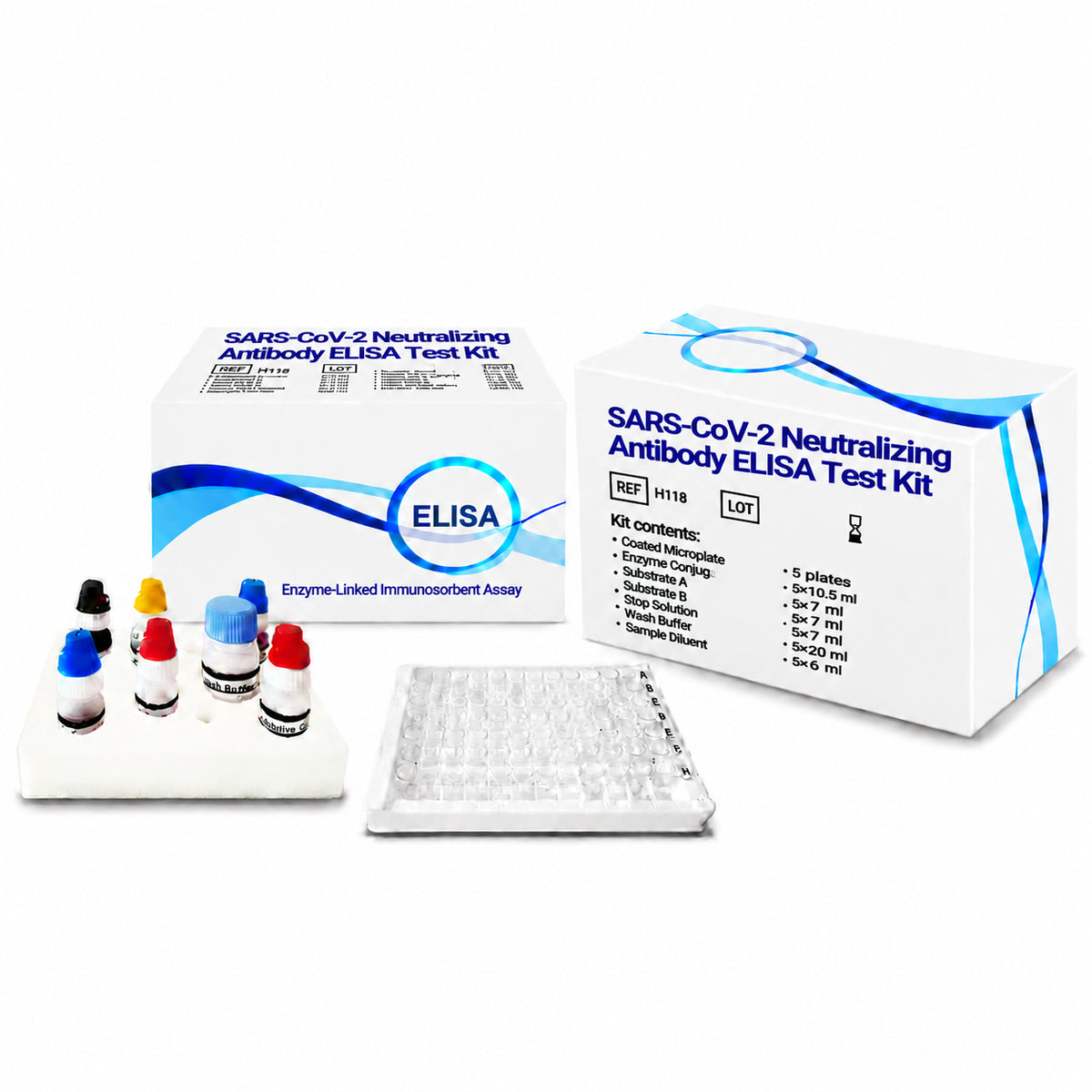
GHM SARS-CoV-2 Neutralizing Antibody ELISA Kit US – 96-Well Competitive Inhibition ELISA for Determination of SARS-CoV-2 RBD-Blocking Antibody Activity in Serum & Plasma (96T/Kit)
GHM SARS-CoV-2 Neutralizing Antibody ELISA Kit US – 96-Well Competitive Inhibition ELISA for Determination of SARS-CoV-2 RBD-Blocking Antibody Activity in Serum & Plasma (96T/Kit)
SKU: GHM SARS-CoV-2 Neutralizing Antibody ELISA Kit US
Brand: Global Healthcare Medical
Product Overview
Global Healthcare Medical GHM SARS-CoV-2 Neutralizing Antibody ELISA Kit US is a 96-well enzyme-linked immunosorbent assay (ELISA) designed for the determination of antibody activity that blocks the interaction between the SARS-CoV-2 spike receptor-binding domain (RBD) and the human angiotensin-converting enzyme 2 (ACE2) receptor in human serum and plasma specimens. SARS-CoV-2 is an enveloped virus with a positive-sense, single-stranded RNA genome of approximately 30 kb, classified in the genus Betacoronavirus. Its spike (S) glycoprotein forms trimeric projections on the virion surface and is cleaved into an S1 subunit, which contains the receptor-binding domain (RBD) within its C-terminal portion, and an S2 subunit that drives membrane fusion. ACE2 is a type I membrane glycoprotein and zinc metallopeptidase whose extracellular peptidase domain serves as the attachment site for the RBD. The RBD–ACE2 engagement is a defined, measurable protein–protein interaction, and antibodies that occupy the ACE2-contacting surface of the RBD physically preclude that engagement. This product measures that blocking activity as an in vitro molecular interaction parameter, and it is studied within the broader field of protein–protein interaction analysis and antiviral antibody characterisation.
This assay is a competitive inhibition format, not a binding or sandwich format. The solid phase is coated with RBD, the specimen is applied so that RBD-directed antibodies can occupy the immobilised antigen, and enzyme-conjugated ACE2 is then added as the detection reagent. Where an antibody has bound the ACE2-contacting surface of the RBD, the enzyme-conjugated receptor cannot engage, and the enzymatic signal is reduced in proportion to the blocking activity present. The readout is therefore inversely related to the quantity of blocking antibody — a directional relationship that is the opposite of every conventional antigen-capture or antibody-capture ELISA, and one that must be kept in mind when the results are interpreted. Results are expressed as a percent inhibition relative to the assay calibrator rather than as a concentration or a cut-off index.
A further consequence of the format is that the readout is epitope-restricted: only antibodies whose binding site overlaps the ACE2-contact surface of the RBD produce a signal change, whereas antibodies directed at other regions of the spike protein — or at non-blocking faces of the RBD — are invisible to this assay even when present at high concentration. The measurement is thus a functional one, reporting blocking activity against a specific molecular interaction, and it is analytically distinct from a binding assay that quantifies total RBD-reactive immunoglobulin. The kit is configured for a 50 µL sample volume with absorbance read at 450 nm using standard microplate ELISA equipment, supplied in a 96-test/box format with an 18-month shelf life.
Intended Use: For laboratory research use only. This product is not intended for use in diagnostic procedures, not for therapeutic use, and not for clinical decision-making. Results should be interpreted by qualified laboratory professionals in the context of research applications.
Key Features & Benefits
Competitive Inhibition Format Measuring RBD–ACE2 Blockade
The assay utilizes a competitive inhibition format in which the RBD is immobilized on the solid phase, the specimen is applied to allow RBD-directed antibodies to bind, and enzyme-conjugated ACE2 is added as the detection reagent. Signal generation depends on the availability of the RBD surface for receptor engagement: antibody occupancy of the ACE2-contacting face reduces receptor binding, and the enzymatic signal falls accordingly. This is a mechanistically direct design — the quantity being measured is the displacement of a defined receptor–ligand interaction, not a proxy for it. The format therefore reports blocking activity at the RBD–ACE2 interface as an in vitro parameter, and the inverse signal relationship is stated explicitly so that results are not misread as a direct binding magnitude.
|
Feature |
Benefit |
|
Competitive inhibition format |
Measures displacement of a defined molecular interaction |
|
RBD-coated solid phase |
Presents the receptor-contacting surface as the target |
|
Enzyme-conjugated ACE2 detection |
Receptor itself is the detection reagent |
|
Inverse signal relationship stated explicitly |
Prevents misreading as a binding magnitude |
Epitope-Restricted Functional Readout
Because signal depends on physical occupation of the ACE2-contacting surface, the assay registers only the subset of antibodies whose binding site overlaps that interface. Antibodies directed against other regions of the spike protein, or against non-blocking faces of the RBD, do not produce a signal change regardless of their concentration. This is a defining property rather than a limitation: it makes the readout functionally specific — reporting blocking activity against one defined interaction — and it explains why a blocking result and a total binding result for the same specimen need not correlate. Research designs that require total RBD-reactive immunoglobulin are served by binding-format assays, whereas designs that require interface-specific blocking activity are served by this format. Recognising the distinction prevents the two readout types from being treated as interchangeable.
|
Feature |
Benefit |
|
Interface-specific readout |
Reports blocking activity, not total binding |
|
Functional rather than quantitative-binding measurement |
Directly addresses the interaction of interest |
|
Complementary to binding-format assays |
Answers a different analytical question |
|
Distinction stated explicitly |
Prevents conflation of the two readout types |
Defined Molecular Components with Traceable Configuration
Both interacting partners in this assay are well-defined molecular entities: the RBD is a structurally characterised domain whose ACE2-contact surface has been mapped at residue level, and ACE2 is a zinc metallopeptidase whose extracellular peptidase domain carries the RBD-binding site. Because the interaction is defined at the molecular level, the assay configuration is explicitly specified — the identity of the immobilised RBD and of the receptor reagent determines which antibody specificities can register. This traceability is analytically valuable: the RBD is the region in which sequence variation between viral lineages is concentrated, so an assay built on a defined RBD sequence has a defined and statable specificity footprint, which is a prerequisite for reproducible comparison across studies.
|
Feature |
Benefit |
|
Structurally defined RBD antigen |
ACE2-contact surface mapped at residue level |
|
ACE2 as a characterised receptor reagent |
Zinc metallopeptidase with defined binding site |
|
Explicitly specified configuration |
Specificity footprint is statable and traceable |
|
Reproducible across studies |
Prerequisite for cross-study comparison |
Percent Inhibition Reporting Relative to Calibrator
Results are expressed as a percent inhibition calculated from the reduction in signal relative to the calibrator supplied with the kit, rather than as a mass concentration or a cut-off index. Percent inhibition is the appropriate reporting unit for a competitive format because the measured quantity is a relative displacement rather than an absolute analyte concentration: the signal in the absence of blocking antibody defines the reference point, and the reduction from that point defines the result. Because absolute values are configuration-dependent — they vary with RBD coating density, receptor reagent concentration, and assay timing — laboratory professionals should confirm the applicable calculation and calibrator definitions against the kit documentation supplied with each lot, and should not compare percent inhibition values across platforms without establishing equivalence.
|
Feature |
Benefit |
|
Percent inhibition reporting |
Appropriate unit for a relative displacement measurement |
|
Calibrator-referenced calculation |
Defined reference point for every run |
|
Configuration dependence stated explicitly |
Prevents invalid cross-platform comparison |
|
Documented calculation basis |
Supports reproducible interpretation |
Standardized 96-Well Workflow with 50 µL Sample Volume
The assay is formatted for standard 96-well microplate processing with a 50 µL sample volume, absorbance measured at 450 nm, aligning with widely available ELISA readers and washers. The plate layout accommodates the calibrator and specimen wells required for a competitive calculation within a single 96-well plate.
|
Feature |
Benefit |
|
96 tests/box |
Practical batch configuration for research workflows |
|
50 µL sample volume |
Standard ELISA sample requirement |
|
450 nm reading |
Compatible with common microplate spectrophotometers |
|
Single-plate calibrator layout |
Competitive calculation contained within one plate |
18-Month Shelf Life
Extended reagent stability supports inventory planning and reduces replacement frequency in laboratory settings.
|
Feature |
Benefit |
|
18-month shelf life |
Extended inventory stability |
|
Consistent batch supply |
Supports repeatable research workflows |
Kit Contents & Pricing (EXW US Dollar)
|
Product Description |
Package |
Shelf Life |
Price/Kit (USD) |
CPT (USD/Test) |
|
SARS-CoV-2 Neutralizing Antibody ELISA Kit |
96 Tests/Box |
18 Months |
$98.00 |
$1.0208 |
Cost per test: approximately $1.02, based on a 96-test kit configuration.
Product Specifications
|
Specification |
Detail |
|
Model / SKU |
GHM SARS-CoV-2 Neutralizing Antibody ELISA Kit US |
|
Product Type |
Enzyme-Linked Immunosorbent Assay (ELISA) Kit |
|
Intended Use |
Determination of SARS-CoV-2 RBD-blocking antibody activity in human serum or plasma; for laboratory research use only; not for use in diagnostic procedures; not for therapeutic use |
|
Assay Principle |
Competitive inhibition ELISA (RBD–ACE2 interaction blockade) |
|
Target Analyte |
SARS-CoV-2 neutralizing antibody (RBD-directed, ACE2-blocking activity) |
|
Detection Format |
RBD-coated solid phase with enzyme-conjugated ACE2 detection reagent |
|
Molecular Interaction |
SARS-CoV-2 spike RBD binding to human ACE2 peptidase domain |
|
Specimen Types |
Human serum, plasma |
|
Specimen Volume |
50 µL/well |
|
Package Size |
96 Tests/Box |
|
Shelf Life |
18 Months |
|
Reading Wavelength |
450 nm |
|
Total Incubation Time |
Approximately 1.5–2.5 hours (protocol-dependent) |
|
Result Interpretation |
Percent inhibition relative to kit calibrator |
|
Calibration Format |
Relative displacement referenced to kit calibrator (not mass-concentration calibrated) |
|
Regulatory Status |
Manufactured under EN ISO 13485 certified quality management system |
Why Laboratories Choose Global Healthcare Medical
|
Consideration |
GHM SARS-CoV-2 Neutralizing Antibody ELISA Kit US |
|
Competitive inhibition format |
Measures displacement of a defined molecular interaction |
|
Enzyme-conjugated ACE2 detection |
Receptor itself is the detection reagent |
|
Interface-specific functional readout |
Reports blocking activity, not total binding |
|
Structurally defined RBD antigen |
ACE2-contact surface mapped at residue level |
|
Percent inhibition reporting |
Appropriate unit for a relative displacement measurement |
|
Cost-effective research assay |
$1.0208 per test; $98.00 per 96-test kit |
|
18-month shelf life |
Extended inventory stability |
|
Standard 96-well format |
Compatible with routine ELISA equipment |
|
ISO 13485 certified |
Quality management system compliance |
About Global Healthcare Medical
Global Healthcare Medical connects clinical laboratories, research institutions, and blood screening centers with diagnostic reagents and analytical systems designed for reliable operation in demanding healthcare environments. The GHM SARS-CoV-2 Neutralizing Antibody ELISA Kit US is part of our professional ELISA reagent portfolio, developed to support standardized, reproducible laboratory workflows.
Our focus is on dependable analytical performance, clear documentation, and responsive support for professional laboratory operations.